Showing posts with label greek/mediterranean. Show all posts

Tuesday, March 10, 2009

Hummus Pizza

Just a quickie here to tell you all about a revelation that J and I had recently: hummus? AWESOME on pizza.

This particular specimen was made with an appropriately Mediterranean spin, beginning with a generous layer of hummus (a very simple basic recipe flavored with lemon, olive and garlic) topped with chopped fresh broccoli, caramelized onions, pine nuts, and a modest finish of shredded sharp cheddar and grated parmigiano reggiano (the good stuff), all on homemade pizza dough.


This was utterly satisfying as a pizza dinner, despite being way light on the usual fatty toppings. The hummus itself was actually extremely low-fat, because I used some of the liquid from the can of chickpeas to thin it out rather than a whole crapload of olive oil, and made up for the lack of olive flavor by tossing a couple of chopped brined green olives into the food processor. It came out delicious and you'd never know there was virtually no fat added (just 1 tbsp of olive oil for a little richness on the tongue). We've made practically guilt-free pies before by using skim milk ricotta or part-skim mozzarella, but unsurprisingly those pies would never hold a candle to this one when it comes to flavor and all around tummy satisfaction. It was delicious.


Now, I'm wondering just how far we could take this variation to mimic a real NY Italian-America pizza. Chickpeas are pretty much a blank slate when it comes to flavor - I mean sure, they have a taste all their own but they mix well with almost anything. Could we season the hummus with Italian herbs and spices to make a better fake-out for ricotta on a white pie? Could we add fresh tomatoes and basil to the hummus to make sort of a thick marinara paste? I'm not sure, but I totally want to try. And I want to explore the Greek and Mediterranean angle as well - topped with black olives and crumbled feta and Greek-style braised or sauteed greens, man would this be tasty. Or perhaps chicken souvlaki and thin slices of haloumi, cooked under the broiler till golden brown and crispy, then topped with a light, crisp, fresh cucumber salad. Mmmm. Am I drooling? Sorry.

And who says this variation should be relegated to chickpeas? Why not white beans in one of those Italian-style applications, or black or pinto beans to make a Mexican pizza? (Because we all love those - go on, admit it.) It'd be easy to mimic refritos on a pizza this way, without the extra, well, frying. In lard. Which is delicious, but not something I can really allow onto our dinner plates very often.


And as an added bonus to those of you (read: all of us) who are trying to save money on everyday food, this was seriously cheap to make. Less than $1 for a can of chickpeas on sale, and pennies' worth of flavoring ingredients added to make the hummus; half an onion, a small head of broccoli, probably less than $2 worth of cheese; pizza dough is nothing bu flour, yeast, and water in its most basic form, all very inexpensive if you're like me and buy them in bulk; and the pine nuts, while very tasty here, are really an unnecessary indulgence and could be omitted in the interest of tightening the belt a bit more. All told, when you consider that most of what went into this pie were pantry items for us, this couldn't have cost more than $5 or so to make. Not bad, considering how filling and delicious it was.

At any rate, I'd encourage anyone who likes hummus to give this a shot - even if you're not aiming for low-cal or don't care about your fat intake, try it anyway. Its still an incredibly flavorful way to approach pizza in a new way.

Monday, December 15, 2008

Goodness, gracious, great balls o' meat!

Sorry. I couldn't resist.

The meatball is, I think, a vastly underrated thing. Most people think of meatballs as only those things you have with spaghetti and red sauce to make a meal more substantial, or perhaps as the little bite-sized morsels served with sweet-and-sour sauce at new year's eve, or in gloopy brown gravy over egg noodles that somehow get away with calling themselves "swedish". Usually made of beef and with far too few seasonings, quite often lacking pleasing texture or moisture, we're all familiar with the mediocrity of the standard meatball. But does that mean they can't be really, truly GOOD? I don't think so.

I also don't believe that meatballs should be relegated to the dishes above. Ground meat (or chop meat if you're from on Long Island or New Jersey, apparently... I haven't been a New Yorker long enough to hear that phrase without a certain confused tilt of the head) is endlessly versatile, refreshingly inexpensive, and usually quite tasty when its of high quality. When you start with a pound of ground meat - be it beef, pork, chicken, turkey, some sort of game, or a mix of two or three - the possibilities are practically infinite.

That's why last week we decided to devote an entire week of dinners to the humble, forgotten, oftimes-abused meatball. And 4 meals later, we've barely scratched the surface.

------------------

Meal #1: Chicken Koftas Avgolemono

I know, I know, here we go again. But hear me out. This was my brainchild, being still enamoured with the Avgolemono Soup from a month or so back and craving those flavors again, but wanting to mix it up a bit. I knew when we decided on this meatball week experiment that I'd want to do something Greek, and this dish sort of just tumbled out on a whim. Apparently the idea had merit, because J declared it a definite addition to our future dream restaurant menu.


From Wikipedia:

"Kofta ... is a Southeastern European, Middle Eastern and South Asian meatball or dumpling.

In the simplest form, koftas consist of balls of minced or ground meat — usually beef or lamb — mixed with spices and/or onions. The vegetarian varieties like lauki kofta, shahi aloo kofta, and malai kofta are popular in India, as is kofta made of minced goat meat."
More...

Traditional beef or lamb koftas (often made in cigar shapes rather than spherical ones) are delicious in their own right, and deserve a post of their own later this year when the weather gets warmer and we can grill them properly. But for this meal, to remain faithful to the original Avgolemono that was my inspiration, I knew that chicken would be the proper choice.

Each of the components of this dish are simple, but as there are several the prep was a bit time-consuming. First, the meatballs were made with ground chicken that was seasoned with oregano, garlic, lemon zest, crumbed feta, a tiny drizzle of honey and a goodly amount of salt and black pepper. We use the Alton Brown method for cooking, and a pound of chicken yielded a dozen two- or three-bite koftas. While those baked away, I boiled some orzo in chicken stock fortified with a bay leaf and extra black pepper, prepped some baby spinach, carrots, garlic and onions for the sautee pan, and whisked the juice of a lemon into an egg in preparation for the sauce.

The carrots, garlic, and onions were sauteed until just softened, then the spinach was added and cooked until it just started to wilt. By this time the orzo was done, and I drained off the remaining stock in the pan into a bowl to use for the sauce. Finally, when the meatballs were done and resting out of the oven for a few minutes, I made the sauce by adding the hot stock to the lemon-egg mixture slowly, whisking constantly to temper the egg, then heating the mix gently on the stove to allow it to thicken.

To serve, a bed of orzo was laid down on each plate, topped by a generous helping of sauteed spinach, a trio of keftedes, and a few spoonfuls of sauce drizzled all over. Finish with a sprinkle of crumbled feta and some chopped fresh parsley, and you've got yourself a meal.


The flavor of this dish was outstanding, and the meal felt quite healthy with the lean chicken and good green spinach. I know that the sauce needs some work, as it never got to quite the consistency I wanted, and a few bits of egg curdled while it was cooking and needed to be strained out before serving. I think with some tweaks here and there and a good reliable recipe (next time, I'll write it down), J is right - this just might have a place on the menu if we are ever able to open the little cafe we dream about.

------------------

Meal #2 - Almond-crusted Asian Meatballs with Vegetable Stir Fry

Think of these as dumplings without the wrappers and a with a bit more attitude. We've made similar things before with sesame seeds that have come out terrific, but I'm a bit of an almond fanatic so when J suggested the almond crust as something different, I was hardly going to argue.


The meatballs were made with a mix of pork and beef and seasoned with soy garlic, onion, ginger, dry mustard, sesame oil, and a bit of sugar. Before dropping them into their individual muffin cups to bake, each ball got rolled around in some finely-chopped toasted slivered almonds to make a crust. Word to the wise - although the meatballs might seem rather fragile when you're working with them, you really want to press the almonds in there so that they stick. J made these and found that when he tried to be more gentle on the meatballs, the almonds all fell off as they cooked - where they'd been pressed more firmly into the meat, they seemed to adhere and get nice and crunchy as we'd imagined they would.


We ate these with a simple stir fry of sugar snap peas, carrots, green bell peppers, and onions in a basic sweet-and-salty brown sauce, which is hard to screw up and always tasty. The meatballs themselves were tasty but seemed a bit on the bland side - next time we'll up the seasonings by at least half. And my previous comments about the almond-crust aside, the bites were the almonds really got attached to the meat and got super golden-brown and crunchy were absolutely delicious and had great textural contrast. If we can get the crusting technique down next time, I think they'd be insanely good. I'd hate to suggest that they could replace J's current signature Asian meatballs for a party appetizer but, well, I think they could.

----------------------

Meal #3: Curried Turkey Meatballs with Chana Masala

I've been looking for an excuse to make my new favorite chana masala recipe recently, so when J suggested an Indian-style meatball I jumped at the chance. Turkey may seem like an odd match for curry seasoning, but really, it works. Its distinctive earthy flavor was a really good base for all those aromatic spices.


J made these as well, using his own homemade curry powder blend as the main seasoning base and adding a bit of garam masala, sugar, and extra salt and pepper to round out the flavor. Nothing fancy in the cooking step here, just form and drop into the muffin tin to bake, so they were especially easy. I made the chana masala almost exactly the same way as last time, but upped the veggie quotient with some cubed zucchini in place of the potatoes, and it was just as good as I remembered.


This was definitely another winner. The best part was scooping up a bite of chana masala with my fork and spearing a piece of meatball on the end and eating it all together - the meatballs may have tended a bit toward the dry side, so the moisture from the tomatoes and onions and squash really improved the texture, and all of those great Indian spices blending together made for an intense explosion of flavor unlike anything in Western cooking. Quite exciting, really, for a weeknight dinner.

-----------------------

Meal #4: Italian Sausage Ball Pizza

I don't actually have any photos of this one, which is a shame because it was really, really good. Like, almost I-can't-believe-I-made-this good. But, well, because it was so good, we ate it before it even occurred to me to take pictures.

I decided that if we were making meatballs all week, we really ought to do something Italian. But I wasn't about to make spaghetti and meatballs - as a matter of fact, I didn't want regular meatballs at all. But SAUSAGE balls, now that I could get behind. But we didn't just buy sausage - we made it, fresh, from just some ground pork and spices.

Bet you didn't know it was that easy, did you? Well, it is.

A pound of ground pork mixed up with a generous amount of garlic, onion, black pepper, salt, and most importantly, fennel (we used fennel pollen because we didn't have any whole seed, and since we were making the sausage mix the day of rather than ahead of time, it would ensure a more pervasive fennel flavor) created a pretty authentic-tasting Italian-style sweet sausage. The mix was formed into slightly flattened balls and seared in a pan this time around, then sliced to make a more easily distributed pizza topping.

The pizza itself was built on some whole wheat dough I'd been saving in the freezer, starting with a thin layer of J's homemade marinara, a sprinkle of shredded mozzarella, some pieces of brie, and the sliced sausage. Into the oven on the pizza stone at the highest heat we could get for maybe 5-10 minutes, and we had a bubbly, melty pizza with a golden brown crust.

The sausage was perfect here, with just the right amount of savory spice. The creamy brie and mozz complimented it really well, and although the crust was more chewy than crispy, the whole wheat flour gave it a pleasing texture. And with the dough made ahead of time, we were able to make the whole meal in about 25 minutes. Can't really beat that!

---------------------
We have one more meal planned that we never got around to making, which we have high hopes for - venison meatballs in cherry sauce. If it comes out as good as I expect it will, I'll be sure to share it with you. But in the meantime, I highly recommend that you give the lowly meatball a bit of thought, and a chance to elevate itself beyond that boring plate of pasta. Its a blank slate upon which fantastic meals can be built, and deserves a second chance at your table.

Saturday, November 8, 2008

Greek. Again.

I shouldn't be so hard on myself about the Greek-food thing - truthfully, we haven't made anything remotely Greek in weeks, so I guess I'm not THAT obsessed. And if I've gotta be addicted to a particular cuisine, at least this one is pretty healthy. It could be worse - at least I don't have an insatiable hunger for bad Americanized Chinese food. Right? Right.

Anyway, this was the last of a long string of soup-centric meals, and to my mind at least, the best.


I've always seen avgolemono mentioned in the context of a soup, but the name really has a much broader definition. From Wikipedia:

"Avgolemono is a family of eastern Mediterranean sauces and soups made with egg and lemon juice mixed with broth, heated until they thicken but before they boil, so the egg doesn't curdle. Avgolémono is the Greek name, meaning egg-lemon; in Arabic, it is called tarbiya or beida bi-lemoune 'egg with lemon', and in Turkish terbiye." More...

Up until recently, this idea has not appealed to me; my earlier reference to bad American Chinese food is particularly apt, because when I thought about egg being added to soup, I automatically pictured something akin to Chinese egg drop which, quite frankly, makes me gag. The reality, however, is far more pleasant. Rather than ending up with a thick, gloopy broth with ribbons of barely cooked egg running through it, the method for adding the lemon-egg mixture to the soup in this preparation actually tempers and lightens the eggs, serving to only thicken the soup slightly and give it a smooth, velvety mouthfeel. No runny eggs here, my friends, and that's a-ok with me.

Traditionally, avoglemono in its soup form is made very simply, with rice or perhaps orzo and pieces of poached chicken added to the fortified broth. I had intended to actually stick to tradition on this one at first, planning only to add some chopped spinach near the end as well in an effort to get some good green veggies into the meal. However, our spinach went bad before I could cook this (I HATE supermarket veggies...) so I ended up making some other changes and substitutions to compensate. In the end, my version contained chicken, asparagus, and artichoke hearts, with my beloved fregola sardo subbed in for the arborio rice in the original recipe.

And it was good.

Really, really good.


Avgolemono with Asparagus, Artichokes, and Fregola Sardo
Adapted from Avgolemono: Chicken Soup with Egg-Lemon Sauce by Cat Cora

1 large boneless/skinless chicken breast
6 cups chicken broth or stock
1 tablespoons olive oil
1/2 white onion, finely diced
3 cloves garlic, smashed and minced
1 bay leaf
1/2 cup diced peeled carrot
1/3 cup fregula sardo
1/2 cup frozen quartered artichoke hearts, thawed and sliced in half lengthwise
1/2 lb asparagus, woody ends trimmed and stalks cut into 1/2" pieces, tips reserved
1 large egg
1/4 cup fresh lemon juice (I felt this was maybe a bit too much - I needed two lemons to get 1/4 cup of juice, so I think next time I might just use one.)
S&P to taste
Lemon slices or wedges, optional

Place the chicken breast in a saucepan and add enough broth to cover. Place over medium-high heat and simmer until chicken is cooked, 15-20 minutes. When cooked, remove the chicken from the pot and set aside to cool. Add the reserved asparagus tips to the pan to blanch for just a minute or two, until they are slightly softened but still bright green. Remove with a slotted spoon to an ice water bath to stop them from continuing to cook, and turn off the heat under the broth. Set aside.

Meanwhile, add the olive oil to the bottom of a larger saucepan and heat over medium-high heat until shimmering gently. Add the onions and garlic and a pinch of salt, and sautee until they are translucent and softened. Add the bay leaf and carrots and sautee for another 2 to 3 minutes, until fragrant.

Pour in the broth used to cook the chicken, as well as any extra, and bring to a boil. Reduce the heat to medium-low, cover, and simmer about 30 minutes. Pour through a fine-mesh strainer into a large bowl to strain out the vegetables and bay leaf, then pour back into the saucepan and move back over the heat. Don't worry if you still have a few bits and pieces of veg in there - it won't hurt the soup any; in fact, you could even skip this step completely and only remove the bay leaf, if you'd like to make things easier, and it'd be just as good if a little chunkier than this version. I like the simplicity of the finished soup in this recipe, personally - the onions, garlic and carrots are only there to flavor the broth.

Add the fregola sardo and allow to simmer for 10-15 minutes, until the fregola is still slightly al dente.

Meanwhile, whisk the lemon juice and egg together in a bowl and set aside. Cut the cooked chicken breast into cubes, about 1/2"-3/4".

When the fregola is mostly cooked, add in the asparagus, artichokes, and chicken, and continue to simmer until the fregola is completely cooked. Remove from heat and get your egg-lemon mixture.

Using a ladle, add some of the soup broth to your bowl of egg and lemon very slowly, using a whisk to incorporate the hot liquid. You need to do this slowly so that the eggs don't curdle, which would cause that nasty egg drop syndrome. Place your hand against the side of the bowl occasionally to test the temperature of the mix - when it feels slightly warmer than room temperature, you can pour the whole mix back into the pan without danger. Be sure to stir the soup as you add the egg mixture to keep things smooth - the broth should only thicken slightly and should still resemble a broth rather than a sauce or stew. Taste for seasoning and add salt and pepper if necessary. I found that I needed no salt, but added quite a bit of black pepper for just a bit of bite.

Ladle immediately into serving bowls and top with the reserved blanched asparagus tips, garnishing with a lemon slice or wedge if desired.

I think that this could be an extremely flexible recipe; you could add in almost any vegetables you like to cater it to your tastes, or make it vegetarian by omitting the chicken and using vegetable broth. You could experiment with grains, using rice or orzo as is traditional, or perhaps trying something like farro for a nutty, chewy texture that I bet would be especially tasty. And since its reasonably sophisticated on the palate, pretty to look at, and easy to make, I think it would be great for entertaining. Some flatbread or crostini with feta toasted on top would make a great accompaniment. We'll be making this again!

Sunday, August 10, 2008

Gazpacho and Sesame Chicken (but not the way you think)

For the second time in two weeks, we're eating Greek here at "Table for Two?". Well, sort of.

I won't pretend for a millisecond that there is anything traditional or authentic about this meal. Its got a little bit of an identity crisis going on. "Gazpacho... isn't that a Mexican soup?" Well, yes, but this one isn't. "Sesame chicken? Sounds like Chinese takeout." It does, doesn't it? But its not. "You're calling this Greek? I've never seen a Greek meal like that." No, I'd imagine you wouldn't have, but wait, just WAIT till you taste it.


Lets start with the chicken, shall we? Really, this couldn't be simpler. J was inspired by a recipe for "Tahini Turkey Thighs" in the Better Homes & Gardens New Grilling Book, a birthday gift from my parents last year. Their recipe was heavily influenced by Asian cuisine and called for things like soy sauce and rice vinegar, which I'm sure would be good as well but wasn't what we were in the mood for. So he simplified the recipe significantly and made a few subtle changes to swing the dish around from Asia to the Mediterranean, ending up with a marinade of only five ingredients: tahini, toasted sesame oil, honey, and S&P. And substituted chicken. Because frankly, as much as we love turkey, we really felt that this NEEDED to be chicken.

I can't speak for the quality of the original recipe, but J's take on it was delicious. The tahini in the marinade created a really fantastic crust on the outside when the chicken was cooked, and kept the inside moist and tender. The sesame flavor was made even more prominent by the addition of the toasted sesame oil, with just the barest hint of honey sweetness. Next time I think I'd squeeze a bit of fresh lemon over the chicken after cooking, just to further balance out the flavor, but as it stands it was savory and aromatic and wonderful.


The soup was, I think, a bit of a revelation for J and a proof of concept for me: gazpacho can, in fact be GOOD, and it doesn't have to be Mexican.

Gazpacho is something that always sounds really great to me in theory, but always disappoints in reality. I mean, I really can't imagine anything more summery and refreshing than a bowl of cold, fresh tomato soup, but anytime I've ever eaten it or made it myself I have really not liked it at all. But recently I had a wonderful lunch at Grayz in Manhattan during NYC Restaurant Week 2008, and my first course was essentially a gazpacho with an Italian twist. Chef Kuntz called it "Two Tomato Coulis with Three Basils", but whatever it was called it absolutely blew my mind. What struck me most was how simple, natural, and fresh the tomato flavor was - it was obvious there was very little in this soup other than the tomatoes themselves, with the upper flavor notes provided by a fresh garnish of chiffonade basil leaves and a drizzle of olive oil. I absolutely had to learn to make it myself.

Further research showed that the soup was just as simple as it seemed - basically its just a bunch of tomatoes all whizzed up in a blender with some garlic, salt, sugar, and white pepper. Thinking about that, I realized that what I don't like about other gazpachos is the other ingredients that get added; the bell pepper, cucumber, onions, jalapeno, and whatever else just cover up the flavor of the tomatoes. The fact that I've never been a big fan of cucumbers probably doesn't help, but for whatever reason it never really occurred to me to leave them out. I almost never follow recipes as-written, but I just never thought about altering this one. I know, it makes no sense to me either. I was tempted to smack myself in the forehead once I figured this out, but was afraid J might think there was something wrong with me.

Anyway, moving on.

I'm going to include the recipe here, because the soup was delicious and I savored every bite just the way it was. However, I think I could execute it better and really clarify the flavors into something much simpler and cleaner on the next go-around, so expect to see this recipe revisited probably in the very near future..

Greek Gazpacho with Fregula Sarda
Fregula sarda (sometimes spelled fregola) is an Italian pasta variety from Sardinia (I know, even MORE of an identity crisis - this poor soup must be so confused). It looks rather like Israeli couscous, but the "grains" are toasted rather than simply dried, providing a distinctly nutty flavor to the cooked pasta. I used them here mainly to add some textural complexity, which worked really well. Its not something that is particularly easy to come by, though, so you could substitute in orzo pasta, rice, or Israeli couscous, or leave it out entirely - it won't affect the flavor of the soup either way.

And yes, I used canned tomatoes for this (for shame!) because they were all I had on hand. Obviously that's something I would change next time around.

1 14oz can diced tomatoes
1 cup chicken or vegetable stock or water
2 cloves of garlic, minced
1 tbsp each fresh chopped oregano and rosemary
1/4 cup sundried tomatoes, chopped
1 pepperoncini pepper, seeded and chopped
1/4 cup green olives, chopped
1 tbsp red wine vinegar
S&P

1/4 cup fregula sarda
1 1/2 cups chicken stock or water

Toppings: fresh lemon juice, crumbled feta, chopped fresh parsley, and good extra virgin olive oil

To make the fregula sarda: heat the stock or water to boiling in a saucepan. Add the fregula and stir to keep the grains from sticking, then cover and cook for 10-15 minutes or until most of the water liquid has been absorbed and the grains are tender. Remove from heat and set aside - the grains will continue to soak up mist of the liquid that is left. If you like, you can rinse them in a colander before serving to remove any residual starches, but I didn't bother.

To make the soup: place all ingredients except for the lemon, feta, and parsley into another saucepan and stir to combine. Place over medium heat and simmer for 10 minutes or so, or until all of the components are soft enough to blend. Remove from heat and either puree right in the pan with an immersion blender (my favorite method) or pour into a standing blender and puree until smooth. The mix could then be strained through a sieve or tammis for a super-smooth product, but again, I didn't bother. Taste for seasoning - I found that my soup needed no salt at all and just a bit of fresh-cracked black pepper. White pepper would also be a good option, but I didn't have any fresh.

Pour the finished soup base into a sealable container (or into a bowl and cover with plastic wrap) and chill for at least an hour. You don't want this to be ice cold, but you don't want it warm either.

To serve, divide the soup base between two bowls. Gently spoon half the cooked fregula sarda into the middle of each bowl, then top with a squeeze of lemon, a sprinkling of feta and parsley, and a drizzle of good olive oil.

********************
Notes for next time: Aside from the fresh vs. canned tomatoes thing, I would like to simplify the soup base a bit by removing the olives and using them instead as a garnish when serving. The rosemary may have been unnecessary, so I think I'd omit it completely. I'd also like to cut out the cooking process, which I think will be a necessity if I use fresh tomatoes, so I'm expecting to need to strain the soup next time around to get rid of any little bits of the tougher ingredients (thinking of the pepperoncini here) that won't break down into the soup without cooking. Other changes may present themselves when I try this again that I can't anticipate right now, but we'll see.

Wednesday, July 30, 2008

In which we indulge our obsessions

I don't know where it come from or why it won't leave, but for the last 6 months or so I have had an all-consuming obsession with Greek and Mediterranean foods. It seems like all I ever want to eat is grilled meats with lots of lemon, olive oil and herbs, or salads topped with fresh salty feta and garlic-stuffed olives, or soft, warm flatbread wrapped around heavily-seasoned falafel patties topped with yogurt sauce and cucumbers. Seriously I just can't get enough of the stuff.

Most of the time I keep my cravings to myself, because although J enjoys the flavors of the Mediterranean as much as I do, he doesn't necessarily want to eat them every single day. And I can understand that. Sort of. Maybe.

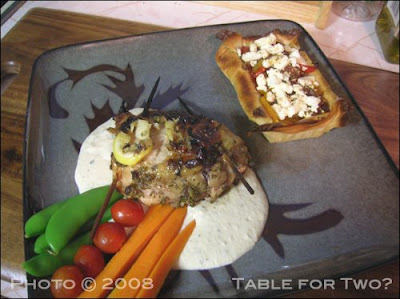
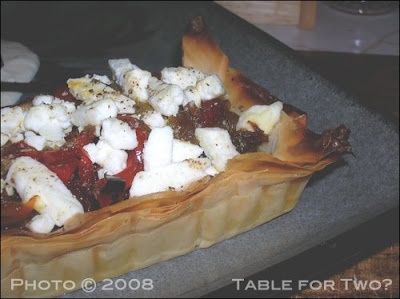
However, during this week's meal-planning session he finally gave me the green light to indulge myself with a light, summery menu of marinated and grilled chicken thighs, hummus, fresh veggies, and a mixed pepper and feta tart. I only had to wait till Tuesday to make it, but its only a slight exaggeration to say it felt like an eternity.


It doesn't end there though. The tart itself was a bit of a treat for me because it gave me an excuse to use some of the brand new, utterly darling mini baking pans that I acquired recently as a birthday gift to myself. A trip to Bowery Kitchen Supply last weekend yielded 4 each rectangular and round mini-tart pans, oval brulees/gratins, and round rammekins, as well as 2 each mini-bundt and springform pans (and I can I just tell you, those springform pans are about the cutest little things I've ever had in my kitchen). Of course, having all these nifty little vessels to work with means that I absolutely HAVE to use them, like, right this very second. What can I say? When I get new things, I need to try them out.

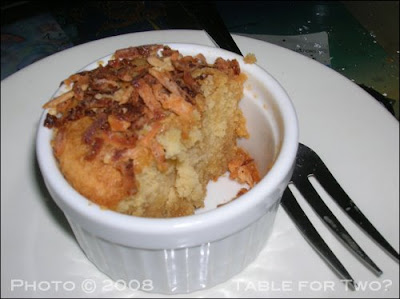
This leads right into the final indulgence of the night - itty bitty personal-sized rum cakes, which is one of J's current obsessions. You see, last summer we joined my family for vacation on St. Thomas in the U.S. Virgin Islands, where we of course enjoyed plenty of good Caribbean rum but also discovered the joy that is the rum-infused cake that is so popular among island tourists. Traditional it may not be, but delicious it most certainly is. Especially when soaked with a syrup made from Cruzan Blackstrap Navy Rum, which has become our new favorite ingredient to experiment with, and topped with black pepper toasted coconut. Sound odd? Maybe, but one forkful will convince you that odd can also be very, VERY good.

The main meal was entirely my own devising, made on (again) a day when I would be home from work and got putter around to my heart's content. That being said, there's no reason you couldn't make it on a busy weeknight with a bit of early prep.

The rum cake was based on this recipe, which I mostly chose because A)it was far simpler than most other recipes I came across, and B)it didn't call for pre-packaged, processed ingredients like boxed cake mix or instant pudding. (Yes, I'm serious - nearly every recipe I saw called for one or the other or both.) Don't get pulled in by those recipes and their promises of easy prep and moist results - this recipe was a breeze to put together and created a dreamily smooth and creamy batter that baked into a dense but moist and delicious cake, made heavenly by a generous soaking in the blackstrap syrup.


Grilled Chicken Thighs with Lemon, Herbs and Hummus-Yogurt Sauce

This chicken benefits from the long marinade in tenderizing citrus, yielding moist, flavorful meat. The hummus-yogurt sauce is just about the simplest thing on earth, especially if you cheat a little bit by using store-bought hummus. Me being me, I made my own, though I'll save that recipe for another post. Do feel free to use your own favorite recipe though - the only important thing is that its nice and smooth so that the resulting sauce has a nice, velvety texture.

2 large chicken thighs, bone-in and skin-on, trimmed of excess skin and fat (if you break down your own bird you probably won't need to worry about this)
Finely grated zest and juice of one lemon, plus 4 wafer-thin slices of a second (I used a meyer lemon for the slices because I like the subtle, floral flavor and scent in this sort of application, but I'm sure a regular lemon would work just fine)
2 cloves of garlic, grated or finely minced
1 tbsp each finely chopped fresh rosemary, parsley, and oregano
1/2 tsp each kosher salt and black pepper
1/2 cup extra-virgin olive oil
sturdy toothpicks or bamboo skewers

1/2 cup each hummus and greek yogurt
1/2 tsp black pepper

Fresh veggies for serving (I chose blanched carrot sticks, sugar snap peas, and fresh cold grape tomatoes)

Combine the lemon zest and juice, garlic, herbs, salt, pepper, and olive oil in a bowl and stir well with a fork or whisk to combine. Set aside.

With your fingers, gently loosen the skin of the chicken thighs to create sort of a pocket between the skin and the meat. Slide two slices of lemon beneath the skin, and use the toothpicks or skewers to reattach the skin to the meat on the edges. I used 2 bamboo skewers per thigh, using a sharp knife to score and break them in half so their length wouldn't make them awkward to handle.

Place the thighs in a shallow dish and pour over the marinade, turning to coat on all sides. Cover with plastic wrap and place in the fridge to marinate for 4-8 hours.

When you're ready to cook the chicken, fire up your grill. We use charcoal, partially because we honestly can't afford a big gas grill but also because I just don't think that the flavor and smell of charcoal-grilled foods can be replicated with propane. Obviously you can use a gas grill if that's what you've got, or even a grill pan on top of the stove, if the weather's nasty or you don't have an outdoor grill. But I'm telling you, the charcoal-fueled open flame cooking method really made this dish.

Once your grill rack is good and hot, place the chicken thighs on the rack skin-side down and cook for 7-8 minutes, then flip and cook on the opposite side for another 7-8 minutes or until the juices run clear. (J, the grill master, would be able to give more detailed instructions on hwo to get just the right amount of charred, smoky goodness on your meat, but as he's currently busy practicing his Rock Band drumming I think he'll have to take a rain check on that little bit of instruction.)

Remove the thighs from the grill, wrap in aluminum foil, and set aside to rest for 5 minutes or so to let the juiced redistribute while you prepare the sauce. And by "prepare the sauce" I simply mean to mix together the hummus, yogurt, and pepper until evenly combined. There, wasn't that easy?

To serve, spoon a generous dollop of the sauce onto a plate and spread into a nice bed for your chicken and veggies. Arrange the veggies on the side of the sauce in an attractive manner, and nestle the chicken right in the middle of the sauce. Every bite of the chicken will come with a blanket of the smooth, tangy sauce. Cue the toe-curl and back-of-the-throat moans of pleasure.


Mixed Pepper and Feta Tart

6 sheets of phyllo dough
2 tbsp melted butter
1 tbsp olive oil
1 cup julienned red, yellow, and orange bell peppers
1/2 cup thinly sliced red onion
1 clove of garlic, finely minced
1 tsp chopped fresh oregano
1/2 tsp sugar
1 tbsp balsamic vinegar
2 tbsp crumbled feta cheese
S&P to taste

If you've ever worked with phyllo dough, you probably know the drill here - layer the phyllo one sheet at a time, brushing a thin layer of melted butter over each layer before topping with the next. Then cut the whole thing in half width-wise (is that even a word?) and lay one half over the other to double the thickness. Cut this in half width-wise again to create two even portions for your crust. (Normally you probably wouldn't use so many layers, but since the tart filling would be a bit on the liquidy side I wanted to be sure it'd be sturdy.

Gently lift and press the dough pieces into two mini rectangular removable-bottom tart pans. There will probably be some overhang, and that's fine. Feel free to shape the edges prettily - I was impatient so I didn't bother.

Bake the shells in a 325 degree oven for about 15 minutes until just golden brown and puffed sligthly. Remove from oven and set aside while you prepare the filling.

Heat 1 tbsp olive oil in a medium skillet, then add the peppers, onions, and garlic. Sautee until they just begin to soften, then add the vinegar, sugar and oregano and cook until they begin to caramelize. Remove from heat and add salt and pepper to taste.

Divide the filling between the two tart shells and top each with 1 tbsp of feta. Switch the oven to broil and place the tart pans on a baking sheet. Place under the broiler and cook until the feta starts to toast and get golden brown on top and the edges of the crust get dark - shouldn't take more than a minute or two. Remove from the oven and set aside until cool enough to handle. To serve, simply support the bottom of the pan and push upward to remove the ring from the outside, then gently slide the bottom from the tart and place on the plate (careful, phyllo is delicate stuff!)


Mmmmm, dessert.


As for the rum cake, all you really need to do is follow the recipe that I linked to earlier. If you want the exact results I got though, I recommend using a good quality amber rum in the cake, and make the syrup with half amber rum and half Cruzan Blackstrap. If you've never tasted really good Navy rum, man oh man are you missing out - its warm and toasty with very heavy flavors of maple and molasses, and though it could be a little overwhelming on its own, it provides just the right deep, dark note to this otherwise lightly-colored cake.

I also added some vanilla and coconut extracts to the cake itself and used equal parts white and light brown sugar rather than all white, but that's not at all necessary. I also baked four small rammekins-worth of batter for individual portions for J and I, and poured the rest into a 9" square baking pan for J to bring to work today - the rammekins took about 45 mins to bake, while the pan took about an hour and 15 minutes.

The coconut topping is incredibly simple but shockingly complex in flavor - just take some sweetened flakes coconut, the kind you get in a bag in the baking supplies section f the grocery store, and toast it up in a pan with a couple shakes of finely ground black pepper. Sprinkle it over the cake before serving and dig in!