skip to main |
skip to sidebar
So, its come to this. I'm making up words now. My college writing professor would either be ashamed or delighted, depending on her mood. But if anything is worth butchering the English language for, its this meal.
Jamie Oliver has wormed his adorably-mop-headed British way into my heart as a chef who really knows his way around good, simple, honest food. J bought me "Jamie at Home", the companion book to his show of the same name, for Christmas last year, and although we've only tried a few of the recipes they've all been winners. (The "Hot and Sour Rhubarb and Crispy Pork with Noodles" on page 58 is a particular hit, but that's a post for another day.) But so far, my absolute favorite recipe from the book is his "Incredible Smashed Peas and Fava Beans on Toast" from page 156, and it was the star of this supremely summer meal.
There's very few things quite as delicious as a bowl of homemade soup and some crusty bread, and our hot-weather take on this common pairing consisted of smooth and creamy vichyssoise and Jamie's fava and pea crostini. Cool, fresh, light, and beautifully green, this meal was both satisfying and refreshing on a muggy August evening.

I made the vichyssoise based on this recipe from Epicurious, and made it the day before we intended to eat it so that it could chill and the flavors blend thoroughly. I made some changes to make it a bit healthier, and to account for the fact that I'd only bought one leek (oops!). I sauteed the white and light green parts of the leek as per the recipe, but reserved the tough dark green tops to infuse the broth later and inject more leeky flavor into the soup. I also added an equal amount of white onion to ramp up the oniony sharpness and better balance the starchy weight of the potatoes. I used a good amount of white pepper instead of black for an earthier kick, and used non-fat Greek yogurt in place of the milk and cream which gave the soup a delicious, though probably non-traditional, tang. I also had to skip the chives because I didn't have any, but I don't think that the soup suffered much for it.

The finished soup was cool, creamy, smooth and savory, with just a bit of heat tingling on the tip of the tongue. It could have used more leek, obviously, but its hard to imagine a better soup on a hot day. Except, perhaps, a simple cold tomato soup, but we've been over that already.
But really, I'd be lying if I didn't say that the soup, as good as it was, paled in comparison to these simple, vibrant green toasts.

The base of the toasts were homemade English muffins (I'll need to make these again so I can blog about them too - they're shockingly easy and perfectly delicious!), split and toasted and brushed with extra virgin olive oil. Thick slices of fresh, lightly salted mozzarella topped the bread, followed by a tumble of fresh, peppery arugula dressed simply with EVOO, kosher salt and coarse cracked black pepper. Then the whole thing got topped off with a big spoonful of the fava and pea mash, made with the aforementioned beans (this really needs to be made with fresh peas and favas - their bright sweetness just sings here - but since I had neither and frankly didn't feel like buying and then shelling enough of them to make this meal, I made do with frozen. It was still excellent.) coarsely pureed with lemon juice, EVOO, salt, black pepper, fresh mint, and a bit of parmesan.
Biting into one of these babies is a little taste of heaven. Sweet, verdant, peppery, and lightly creamy; the smooth mozzarella, tender but lightly textured mash, crisp greens and crunchy bread... I could eat this every day. Its got a little bit of everything, the perfect blending of flavors and textures. And despite its lightness, its surprisingly satisfying. A few of these would make a wonderful lunch all on their own. But paired with a bowl of vichyssoise and a glass of chilled, dry white wine, it was an excellent summer dinner, one I hope to repeat in the very near future.
 Well folks, here it is. The last Barefoot Bloggers recipe challenge for 2008. I've only been a member for 4 months, but I've had a great time trying out all of these new dishes and I can't wait to see what the new year holds for our little group. Happily, we're closing the year on a good note, as this was one of the best tomato soups I've ever made.
2008's final challenge, Pappa al Pomidoro, was chosen by Natalie of Burned Bits, and is an easy and delicious tomato-basil soup thickened with hearty ciabatta bread. I am a total sucker for tomato soup (its almost embarassing but I even love Campbell's tomato soup) and am always excited to try a new recipe. Its the sort of warm, satisfying meal that is ideal for chilly winter nights, and this one was no exception. What's different about this tomato soup is that where I would normally want a grilled cheese sandwich or a small salad to go with, this soup was hearty and filling enough to make a perfect dinner without accompaniment.

I managed to stay pretty true to Ina's recipe this time around, only really taking liberties with the garnishes, but I'll get to that soon enough.
Making the soup really couldn't be simpler. It begins with a flavor base of onions, garlic, carrots and fennel, which are sauteed in olive oil until softened and just beginning to take on some color. Then, the secret to this soup's thick, velvety texture is added - cubes of fresh ciabatta bread. We found some roasted garlic ciabatta at the store, and the extra hit of sweet garlic flavor made the finished product even more complex.
After allowing the bread to cook and toast slightly in the oil, a big can of crushed Italian plum tomatoes (mine had garlic and basil added) gets poured into the pan, along with some good red wine, chicken stock, and fresh basil. Once combined, the soup now simply needs to simmer for 45 minutes until everything is soft and the flavors are melded.

While the soup cooks, there's time to prepare some over-the-top garnishes. Ina instructs you to toss together more cubed ciabatta with cubes of pancetta, whole fresh basil leaves, and seasoned olive oil, then spread the mix on a baking sheet to toast in a high-temperature oven. I decided to get a little creative here, and instead of using diced, thick-cut pancetta, I bought some thin-sliced pancetta and roasted them flat on the baing sheet to create pancetta crisps. The fresh basil was cut into a chiffonade before being tossed with the bread and EVOO as directed, and 10 minutes in the oven yielded blackened basil strips clinging to crunchy, golden brown, aromatic croutons. I tasted one after they cooled a bit, and was hard pressed not to keep munching on them afterwards - they were the best croutons I've ever made.
Once the soup had cooked for a sufficient amount of time, I decided to go against Ina one more time and buzz everything up with my stick blender rather than leaving it rustic and chunky, because I just love a silky smooth soup. I guess I really just like the way all of the flavors combine when everything is blended together. Once blended I stirred in a handful of shredded asiago; Ina calls for parmesan, which I have no doubt is delicious (because when is parmesan cheese not delicious?) but we were buying asiago for other meals that week and decided it wasn't worth buying a whole extra block of cheese. The sharp flavor of the asiago really worked well though with the other savory flavors in the soup.

To serve, we ladled the soup into bowls and topped with an extra sprinkle of asiago, a handful of basil croutons, and two pancetta crisps. And man oh man, was it GOOD. The soup was savory and ever so slightly sweet, velvety and hearty, with a bit of creaminess from the cheese (I think a drizzle of cream added at the end would really throw this over the moon) and really would have been great all on its own. But honestly its the garnishes that made it so special. The crunchy garlicky croutons and toasty basil and the pancetta crisps crumbled over the top before eating made for exciting textural contrast in every bite, with the occasional burst of porcine saltiness. Seriously, incredibly delicious.
And believe it or not, this soup tasted even better the next day as leftovers for lunch.

This just might become my go-to tomato soup recipe, especially for entertaining. Its so easy, yet the garnishes and smooth texture make it impressive enough to serve to guests. Its even festive for the season, all red and green!
I'm considering making a big batch of this soup and jarring it, so that I can have delicious tomato soup anytime I want. I could probably eat this stuff every day. Thanks, Natalie, for choosing this fantastic recipe!
Hi folks! We're away on vacation, visiting J's parents in the wilds of Wyoming for the Thanksgiving holiday. I actually wrote this post almost two weeks ago, because I knew we'd be gone when it was supposed to go up, and I didn't really want to think about it in the days leading up to our departure.
Wyoming isn't exactly known for great cuisine, but I know we'll be making one hell of a Thanksgiving dinner with the folks, so I'll be sure to embarrass myself and take lots of pics to show y'all when we get back. Hope everyone has a fun-and-food-filled Turkey Day!
This week's Barefoot Bloggers recipe is Ina's Mexican Chicken Soup, chosen by Judy of Judy's Gross Eats. As far as I can tell, this is basically just Ina's riff on a chicken tortilla soup, but I certainly can't find fault with that - I love soups, I love tex-mex flavors, and unsurprisingly, I loved this recipe.

I have to admit, I kinda screwed up a bit on this because, well, I didn't read the entire recipe all the way through before we did our grocery shopping last weekend. Shame on me. I totally missed that the corn tortillas were not, in fact, intended to be baked or fried for the tortilla chip garnish mentioned at the end of the recipe, but were actually supposed to be added to the soup as a thickener. Since we usually skip the chips when it comes to Mexican soups and chillis, I didn't buy the tortillas. And then I pulled up the recipe on the night we were going to make this, and realized my mistake. Whoopsie!
Luckily, I had a box of quick-cooking polenta in the pantry, and figured that a few tablespoons of that added in near the end of the cooking time would basically accomplish the same thing as the tortillas added near the beginning - it'd thicken the soup, give it some really interesting texture, and infuse a bit of subtle corn sweetness into the final flavor. And in the end I think it worked just fine, and both J and I really enjoyed it just the way it was. Unfortunately that means I can't really weigh in on the success of the recipe as written, but I think the food gods will forgive me just this once.
Aside from that one little foible, I pretty much made the recipe as written with just two small changes. I used dry cilantro instead of fresh, because I just can't bring myself to buy fresh cilantro anymore unless we're going to be using it in every meal for a week. Its impossible to get anything but a bunch the size of my head around here, and every single time we buy it we end up have to throw half of it out because we can't use it fast enough. Given the price of fresh herbs, I just can't keep letting that happen. Also, I substituted a long hot chili (a serrano, I think?) instead of the 2-4 jalapenos that Ina's recipe calls for, mostly because I'm a total wuss and that much jalapeno would probably kill me, but also because we had this other chili lying forlornly in our vegetable drawer and I wanted to use it up before buying more. It actually ended up being the perfect choice, because it definitely added some heat, but not enough that I needed a loaf of bread and a handkerchief to get through the meal. Got my sinuses to open up a bit though, that's for sure.
I guess I should also include the fact that we used some of the leftover chicken from the roast bird we made the weekend before instead of roasting fresh chicken breasts just for the soup, but that's kind of a no-brainer as far as I'm concerned, and all it basically changed was the amount of time needed to make this soup from start to finish.

Unfortunately, my other screw-up was forgetting to bring my camera and tripod into the kitchen while making this, so I don't have a bunch of photos of the raw ingredients and prep work to share this time. Honestly though, this recipe is so easy, I doubt you need the photographic help.
The technique is basically the same as almost every other soup I make - sautee the base flavor ingredients (in this case a standard mire poix with the hot chili and some garlic added in) in some olive oil at the bottom of your soup pot until they are softened and beginning to brown a bit. Toss in your liquid ingredients, herbs and spices (chicken stock, canned tomatoes with their juice, and some cumin, coriander seed, and dry cilantro) then bring to a boil and let 'er rip for awhile to get the veg nice and soft. Give it a taste for seasoning - I found it needed a bit more of both cumin and coriander for my tastes, and I threw in a splash of red wine vinegar for a bit of balancing tang. Then add in the chicken, followed by about 1/4 cup of quick-cooking polenta, which I added very gradually while stirring constantly to avoid clumps. Keep it on the heat for another 5 minutes so that the polenta can rehydrate and thicken the soup nicely, making sure to stir once in awhile to keep things from sticking on the bottom. Once its done, ladle it into some bowls and top with a dollop of sour cream (I spiked ours with a bit of fresh lime juice) and a sprinkling of cilantro. Couldn't be easier, really.
We enjoyed our soup with a double-decker quesadilla made with these fantastic multigrain tortillas from Mission and some fancy Sargento shredded cheese (2 varieties, one with seasoning and one without), which is frankly one of my favorite things in the world to make and eat because its so easy its almost stupid and well, is there really anything better than tortillas stuffed with gooey, melty cheese? I don't think so.
All you do is heat up a large, flat pan on the stove (we use an old, warped griddle pan that desperately needs to be replaced but still does the job) and brush one side of one tortilla with some melted butter or vegetable oil. Put it on the hot pan, lube-side down, and top with a decent sized pile of one kind of cheese, spreading it around to make an even layer. Top the cheese with a second tortilla (no oil or butter needed here), then top that with a second kind of cheese. Finished with a third tortilla, again brushed with butter or oil and this time placed lube-side UP so that when you flip it, the oil will come in contact with the pan. Weigh down with a flat pot lid or a plate to help the bottom tortilla get nice and crisp and brown and to help the cheese melt, and let it sizzle away for a few minutes. Check after 3 or 4 to be sure its not burning, but don't flip it until you see plenty of golden toastyness down there. When you DO flip, do so carefully in case there is cheese in that top layer that isn't quite melted yet and the thing doesn't stay together - you really don't want shredded cheese flying all over your kitchen. Trust me. Now put the pot lid or plate back on top of the quesadilla and give it another 2-3 minutes to crisp up on the second side. When its done, just cut it into wedges with a pizza cutter or a big, sharp knife (a chef's knife or santoku works well) and serve. The wedges make absolutely awesome dippers for this soup.

I would totally make this dinner again. I'd make it all the time, in fact. Its hot, spicy, hearty and comforting, and a really nice change from a regular bowl of beef-and-beans chili. And, well, anything that gives me an excuse to make quesadillas is just fine in my book.
Its a crying shame that J managed to get all the leftovers, because I could really go for a bowl right now.
I shouldn't be so hard on myself about the Greek-food thing - truthfully, we haven't made anything remotely Greek in weeks, so I guess I'm not THAT obsessed. And if I've gotta be addicted to a particular cuisine, at least this one is pretty healthy. It could be worse - at least I don't have an insatiable hunger for bad Americanized Chinese food. Right? Right.
Anyway, this was the last of a long string of soup-centric meals, and to my mind at least, the best.

I've always seen avgolemono mentioned in the context of a soup, but the name really has a much broader definition. From Wikipedia:
"Avgolemono is a family of eastern Mediterranean sauces and soups made with egg and lemon juice mixed with broth, heated until they thicken but before they boil, so the egg doesn't curdle. Avgolémono is the Greek name, meaning egg-lemon; in Arabic, it is called tarbiya or beida bi-lemoune 'egg with lemon', and in Turkish terbiye." More...
Up until recently, this idea has not appealed to me; my earlier reference to bad American Chinese food is particularly apt, because when I thought about egg being added to soup, I automatically pictured something akin to Chinese egg drop which, quite frankly, makes me gag. The reality, however, is far more pleasant. Rather than ending up with a thick, gloopy broth with ribbons of barely cooked egg running through it, the method for adding the lemon-egg mixture to the soup in this preparation actually tempers and lightens the eggs, serving to only thicken the soup slightly and give it a smooth, velvety mouthfeel. No runny eggs here, my friends, and that's a-ok with me.
Traditionally, avoglemono in its soup form is made very simply, with rice or perhaps orzo and pieces of poached chicken added to the fortified broth. I had intended to actually stick to tradition on this one at first, planning only to add some chopped spinach near the end as well in an effort to get some good green veggies into the meal. However, our spinach went bad before I could cook this (I HATE supermarket veggies...) so I ended up making some other changes and substitutions to compensate. In the end, my version contained chicken, asparagus, and artichoke hearts, with my beloved fregola sardo subbed in for the arborio rice in the original recipe.
And it was good.
Really, really good. Avgolemono with Asparagus, Artichokes, and Fregola SardoAdapted from Avgolemono: Chicken Soup with Egg-Lemon Sauce by Cat Cora
1 large boneless/skinless chicken breast
6 cups chicken broth or stock
1 tablespoons olive oil
1/2 white onion, finely diced
3 cloves garlic, smashed and minced
1 bay leaf
1/2 cup diced peeled carrot
1/3 cup fregula sardo
1/2 cup frozen quartered artichoke hearts, thawed and sliced in half lengthwise
1/2 lb asparagus, woody ends trimmed and stalks cut into 1/2" pieces, tips reserved
1 large egg
1/4 cup fresh lemon juice (I felt this was maybe a bit too much - I needed two lemons to get 1/4 cup of juice, so I think next time I might just use one.)
S&P to taste
Lemon slices or wedges, optional
Place the chicken breast in a saucepan and add enough broth to cover. Place over medium-high heat and simmer until chicken is cooked, 15-20 minutes. When cooked, remove the chicken from the pot and set aside to cool. Add the reserved asparagus tips to the pan to blanch for just a minute or two, until they are slightly softened but still bright green. Remove with a slotted spoon to an ice water bath to stop them from continuing to cook, and turn off the heat under the broth. Set aside.
Meanwhile, add the olive oil to the bottom of a larger saucepan and heat over medium-high heat until shimmering gently. Add the onions and garlic and a pinch of salt, and sautee until they are translucent and softened. Add the bay leaf and carrots and sautee for another 2 to 3 minutes, until fragrant.
Pour in the broth used to cook the chicken, as well as any extra, and bring to a boil. Reduce the heat to medium-low, cover, and simmer about 30 minutes. Pour through a fine-mesh strainer into a large bowl to strain out the vegetables and bay leaf, then pour back into the saucepan and move back over the heat. Don't worry if you still have a few bits and pieces of veg in there - it won't hurt the soup any; in fact, you could even skip this step completely and only remove the bay leaf, if you'd like to make things easier, and it'd be just as good if a little chunkier than this version. I like the simplicity of the finished soup in this recipe, personally - the onions, garlic and carrots are only there to flavor the broth.
Add the fregola sardo and allow to simmer for 10-15 minutes, until the fregola is still slightly al dente.
Meanwhile, whisk the lemon juice and egg together in a bowl and set aside. Cut the cooked chicken breast into cubes, about 1/2"-3/4".
When the fregola is mostly cooked, add in the asparagus, artichokes, and chicken, and continue to simmer until the fregola is completely cooked. Remove from heat and get your egg-lemon mixture.
Using a ladle, add some of the soup broth to your bowl of egg and lemon very slowly, using a whisk to incorporate the hot liquid. You need to do this slowly so that the eggs don't curdle, which would cause that nasty egg drop syndrome. Place your hand against the side of the bowl occasionally to test the temperature of the mix - when it feels slightly warmer than room temperature, you can pour the whole mix back into the pan without danger. Be sure to stir the soup as you add the egg mixture to keep things smooth - the broth should only thicken slightly and should still resemble a broth rather than a sauce or stew. Taste for seasoning and add salt and pepper if necessary. I found that I needed no salt, but added quite a bit of black pepper for just a bit of bite.
Ladle immediately into serving bowls and top with the reserved blanched asparagus tips, garnishing with a lemon slice or wedge if desired.
I think that this could be an extremely flexible recipe; you could add in almost any vegetables you like to cater it to your tastes, or make it vegetarian by omitting the chicken and using vegetable broth. You could experiment with grains, using rice or orzo as is traditional, or perhaps trying something like farro for a nutty, chewy texture that I bet would be especially tasty. And since its reasonably sophisticated on the palate, pretty to look at, and easy to make, I think it would be great for entertaining. Some flatbread or crostini with feta toasted on top would make a great accompaniment. We'll be making this again!
I wonder sometimes what all the other food bloggers do for a living, whether or not they have non-blogging hobbies, how long they actually spend on their blog posts... because I just can't figure out how to keep up! I have a four-part series of posts planned on how to make and use a whole smoked chicken, several nightly meals and lessons-learned types of posts to write, and we're still cooking every night so the list just keeps getting longer. Perhaps I'm not prioritizing my posts well, or perhaps I'm just not devoting enough time to this, but honestly, some nights I just want to plunk my butt on the couch and watch cartoons and don't want to go near my computer or the internet.
And all that's just a long-winded way of saying I've got a ton of posts lined up, but I'm being slow about actually posting them. And now I'll have to line-jump a bit, because its Barefoot Bloggers time again, and I've got Cream of Wild Mushroom Soup to share with y'all (chosen by Chelle of Brown Eyed Baker) and I'm already late on this.

I gotta admit, I sorta dropped the ball on this one. I nearly forgot until we were halfway through our weekly shopping trip at Iavarone and I wandered past a display of dried porcini mushrooms and sorta froze in my tracks as the realization slowly came to mind that I was supposed to be making soup this week and I HADN"T CHECKED THE RECIPE. I had no idea what I needed, beyond the obvious - mushrooms, some sort of liquid dairy product. Probably butter. No clue.
So, I had to wing it. We bought white button mushrooms and shiitakes, and a package each of dried porcinis and dried morels (totally unnecessary but hey, what the hell). I bought some 2% milk, because I did remember that the recipe called for both half-and-half and heavy cream in pretty large quantities and there was just no way I was making it as written. I'm the kind of person who'd just need to look at a bowl of soup that rich and I'd gain 5 lbs. No sir, this recipe needed to lighten up a bit.
Getting back to the point, though, I sort of trusted to my pantry and fridge to supply me with any other ingredients for the soup, and for the most part, I got lucky - we had a single leek hanging out in the crisper drawer from last week, some dried thyme on the wall-o-spice (remind me to share some pictures of that soon) and fresh parsley wrapped up in a damp paper towel in the fridge, I had butter and flour already since they're pretty standard pantry items. Of course it was at this point that I looked at the recipe and realized I'd forgotten the portobellos, but I figured that white buttons are just a milder version of creminis, which are a baby version of portobellos, so they'd probably be an ok substitution. Especially since I'd be using porcinis and morels, some of the most flavorful mushrooms in the world. I wasn't too concerned.
And then, last night, I started pulling things out of the fridge and off the pantry shelves to make the soup for dinner, and brought the recipe up on my computer to check on the order of operations.
That's when I saw the white wine on the ingredients list, and realized I didn't have any.
That's also when I realized I'd stupidly used up all the white button mushrooms in dinner the night before, completely forgetting that I STILL HAD TO MAKE SOUP.
Staring at my motley mis en place, I realized that with my intentional substitutions and accidental omissions, this soup was hardly going to resemble the Ina's original. Dammitall, and it's only my second BB recipe. FAIL.

But, we still needed dinner and I still needed to make something to post, so I figured that with as much as I was already changing the recipe, I'd just try to follow Ina's method and wing the rest.
And honestly? It was great. It was rich, silky, highly aromatic and flavorful, but not at all heavy. I know that had I made the soup with the amounts of half-and-half and cream that the recipe called for, I would've been hard-pressed to eat more than a few spoonfuls of it. But this lighter version had all the flavor without all the heavy dairy fat, and I was able to enjoy a whole bowl of it without feeling like I'd swallowed a 5lb boulder. Much the opposite, in fact - my substitution of lemon juice for white wine made the finished soup light, tangy, and fresh.
Because I changed the recipe so much, here's my version. I can't speak for the original, though I'm sure its delicious, but I think this is a great lighter alternative that I hope at least stays true to the spirit of Ina's recipe.
------------------------
Creamy Wild Mushroom Soup with Lemon and Thyme
Based on Ina Garten's Cream of Wild Mushroom Soup
I didn't really measure a lot of things while making this soup, so I'm giving remembered approximations here. If I make this again, I'll be sure to pay better attention to measurements and post an updated recipe. I will say that I tried to half most of the measurements in Ina's recipe, and it made exactly the right amount for two people as a side with dinner.
Feel free to mix and match mushroom varieties here - as long as you've got at least 2-3 kinds, and at least one of which is very flavorful (like porcini) you should end up with a very tasty soup. This particular combination worked well for me, but as it was almost entirely unintentional I would not be surprised if there's one that's better.
4-5 large fresh shiitakes
1/4 each dried porcinis and dried morels
1 cup boiling water
1 carrot, diced
1 stalk of celery, diced
1/2 white onion, diced
1 leek, diced and rinsed well
5 cloves of garlic, smashed
1 tbsp EVOO
2 1/2 cups chicken stock or broth
3/4 cup milk (I used 2%, but anything other than skim would probably work fine)
1 tbsp butter
1 tbsp flour
1 tbsp creme fraiche
juice of one lemon (about 1/8 cup)
1 tsp dried thyme (or a couple sprigs fresh)
1/2 tsp black pepper
salt to taste
Place the porcinis and morels into a bowl and pour over the boiling water. Let stand for 20-30 minutes or until the mushrooms have softened.
Wipe the shiitakes clean with a damp towel. Separate the stems from the caps and set aside, then dice the caps into bite-sized pieces.
Heat the oil in a large saucepan over medium heat. Add the carrot, onion, celery, and garlic (and fresh thyme if you're using it). Chop the shiitake stems and add them to the pot as well. Cook the veg gently until they begin to soften, but do not brown, about 5 minutes. Add the stock and bring to a boil, then reduce the heat and simmer for about 30 minutes. The stock will reduce to probably closer to 1 1/2 cups. At this point, remove it from the heat.
Remove the porcinis and morels from their hot tub and rinse very well in a colander, then dry slightly on a paper towel. Chop the porcinis and morels relatively finely. (Personal preference - I love the flavor of dried mushrooms but not the texture, even after they've been reconstituted, so chopping them finely cuts down on the unpleasant mouthfeel for me. You can chop them more coarsely if you don't have my ridiculous hangups.)
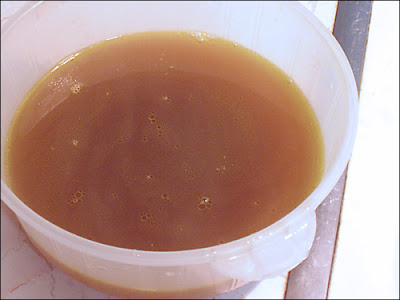
Line the colander with cheesecloth (I used 4 layers) and strain the water that the mushrooms soaked in into a bowl - this will remove any dirt and grit and leave you with a deliciously fragrant mushroom broth. Rinse the cheesecloth, put it back into the colander, and strain the enhanced chicken stock into the same bowl as the mushroom broth. Twist up the cheesecloth and squeeze it to get as much liquid out of the veg as possible (be careful if its still hot!). Discard the veg and set the stock aside.
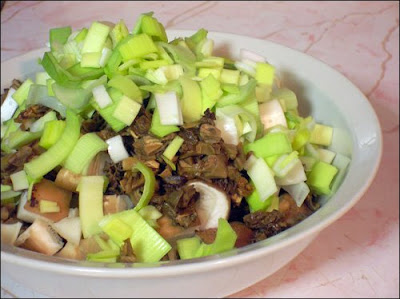
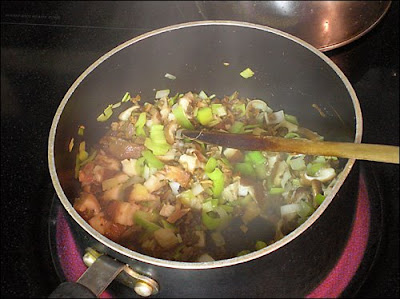
Clean and dry the saucepan you used to make the stock and put back on the stove at medium heat. Add the butter - when it melts, add the diced shiitake caps, chopped porcinis and morels, diced and rinsed leeks, dry thyme, and pepper. Sautee until the musrooms and leeks are softened and have given up most of their water and are starting to brown around the edges. Deglaze the pan with the lemon juice, and cook a minute or two more until most of that liquid has evaporated/been absorbed. Add the four and stir to coat all the veg in the pan evenly, and cook for another minute or so to get rid of the raw flour taste.
Slowly add the stock back to the pan, stirring constantly to ensure no lumps form. Once all the stock has been incorporated, bring to simmer just to be sure its heated properly, then remove from the heat. Add the milk and creme fraiche, then taste for seasoning and add salt as needed. If desired, garnish with some chopped fresh parsley. Serve immediately.

We ate this with some red-wine braised hanger steak and simple sauteed spinach, which made for a pretty decent steak-house-dinner-at-home sort of meal. The steak was actually especially interesting to us because after braising it, J tossed it into a really hot cast iron skillet to sear the outsides, and although the end product was a touch on the dry side, it had a very similar texture and flavor to pork carnitas. Which got us thinking - could we use this alternative cooking method to make an Italian or Mediterranean beef carnitas? Probably. This may be revisited later.
Working in a university, you start to measure your life in semester-length increments. You learn that the from summer into early fall, the time of year when most people are busy relaxing and doing nothing, you'll be tearing your hair out trying to keep dozens of meetings straight and finishing all your big projects before The Day The Kids Come Back.
Summer at a university is not the time for taking it easy; its the time for getting all the work done that you can't do during the year when the students and faculty are around to occupy your time.
And THEN, the fateful day arrives and the new academic year begins, and suddenly everyone on campus has taken a renewed interest in the services you're there to offer, and if you thought things were busy in the three months previous you've got NO idea, brother. In a week's time, I think I had more meetings and new project requests than I'd had all summer.
Think about that for a second, and you'll understand why by last Thursday I needed fried veal and potato soup for dinner.

J, being of almost entirely German heritage, has an understandable devotion to Eastern European fare. Unfortunately, since most of the German foods he (and I) love basically consist of meat, potatoes, and cabbage, usually with a fair amount of fat thrown in for good measure, we don't cook it very often. But Iavarone had some lovely little thin veal cutlets over the weekend and J was inspired to put a couple of German meals on the menu for the week. Luckily for me, it just happened to work out that we had both meals on days when I really, really needed them.
The weekend previous I made a batch of homemade pierogi stuffed with potato and onion and froze them, so that on Monday, when I came home at 9pm after a long work day follows by a two-hour chorus rehearsal, J greeted me with a hug and a kiss and a steaming plate of kielbasa, sauerkraut, and pan-fried pierogi. *swoon* Be still my heart... there is nothing sexier than a man who'll cook for me.
Then on Thursday, when I had 4 excrutiatingly long days behind me but still one more to go and was feeling about as tired as I've felt in months, J made wienerschnitzel with mushroom gravy and I made creamy potato soup with broccolini and caraway and a spoonful of crispy diced kielbasa on top, and all of a sudden things seemed a whole lot better.

Potato-Broccolini Soup with Kielbasa and Caraway
1 large russet potato, peeled and diced
1 bunch broccolini, cut into 1/4-1/2" pieces
2 garlic cloves, smashed
1/2 cup diced white onion
3 cups chicken stock
1 tsp caraway seed
1 tsp spicy brown mustard (I used Boar's Head because its what we had, but would have preferred something grainier)
1 tbsp creme fraiche
1/2 cup diced kielbasa
2 tbsp butter
S&P to taste
Melt 1 tbsp butter in a large saucepan over medium-high heat. Add the onions and garlic and sautee until slightly softened and translucent, but not browned. Add potatoes, broccolini (reserving about 1/4 cup), and caraway seed and sautee for a minute or two just to get things up to temperature. Add the stock and bring to a simmer. Cook until the potatoes and broccolini are soft enough to mash with a fork.
Meanwhile, heat the remaining tbsp of butter in a small sautee pan and add the kielbasa and remaining broccolini. Cook, stirring occasionally, until the sausage and veg are heated through and slightly browned and crispy on the outside. Remove from heat and set aside.
When the veg in the soup is smashably-tender, remove from the heat and add the mustard and creme fraiche, stirring to combine evenly. At this point you could serve the soup as is, but I chose to put my trusty immersion blender to work and whizzed everything up until it was velvety smooth. Not that I have anything against chunky soup, but this had the added benefit of pureeing the caraway along with the veg, making for a more consistent flavor. You could grind the caraway before adding to the pot if you wanted to get around that but still have a chunky soup, but I'm frankly too lazy for that mess.
To serve, ladle into bowls and gently top with a big spoonful of the crisped kielbasa and broccolini. Enjoy while still hot, preferably with a big hunk of dark pumpernickel bread or a plate of your favorite German dish. Like wienerschnitzel, especially if its cooked by someone as inarguably German as J.
Pairing this with a glass of riesling or a gin and tonic (preferably something good like Tangueray) is just gilding the lily... I'm quite a fan of gilded lilies, myself.
...ok, if that title didn't send you running for the hills in disgust, you have my thanks. Really, I'm not a totally cold-hearted b*tch. Honestly, I'm not. But there are very few animals that I wouldn't ever consider eating, and rabbits are not one of them. (Cats and dogs, though, are another story.)
The story goes like this - over a year ago, I discovered that our butcher at the time carried rabbit. Frozen, unfortunately, but as this was a relative delicacy that I have yet to see anywhere else, I just couldn't resist the temptation to buy one. As it happened, I bought two. And they've been languishing in our freezer ever since, because we just never thought of a way to try cooking them that really appealed to us. Sure, I found plenty of recipes for rabbit stew and rabbit braised in wine and rabbit pies and other similar things in my online search for ideas and guidance, but we just never got to the point where any of those things seemed like something we felt like eating. A lot of this was because we felt that with a new ingredient, one that neither of us had ever had the opportunity to even try, we wanted to make something that would really feature its flavor, rather than hiding it in a soup or sapping it in a braise.
Also, for awhile we honestly just forgot that we had them.
But a couple of weeks ago we found ourselves dealing with some tight finances until payday, and we wanted to use up some various odds and ends that we'd been saving rather than buying a bunch of new, fresh meat. Thus, one of our little icy bunnies made it onto the menu.
The inspiration? Traditional creole and cajun cuisine; namely, rabbit and sausage gumbo.
I know what you're thinking. "That doesn't look like any gumbo I'VE ever seen." And you'd be right. Because we didn't really make gumbo. We deconstructed it.
Deconstructed dishes tend to be sort of a trendy, high-brow sort of thing, but I think the idea has a lot of merit when thinking about single dish foods like soups, stews, baked goods, or other things that use many disparate ingredients to create a single harmonious whole. While such things can be completely delicious as they are, there is a lot of land to be explored when you consider each individual ingredient as a meal component in and of itself.
When making a normal gumbo, all of the bits and pieces combine and meld to make a bowl of goodness that has a truly tasty overall flavor, but those individual ingredients lose their identity, sacrificing individuality for unity. Deconstructing this dish allows each component to shine.
The rabbits themselves were packaged whole with certain organs still attached, mostly notably the kidneys. Breaking down the rabbit naturally fell to me, as I seem to have developed a bit of a knack for breaking down whole birds like chickens or turkeys. The rabbit, though, was well and truly a whole different animal. I suppose the basic structure was the same, but there were bones in odd places, and the mid-section of the animal was so lean I wasn't even sure if the bits surrounding the rib cage were actually meat or just especially thick skin. In the end I decided upon the latter, and I ended up quartering the rabbit (front and hind quarters on both sides) and removing what I believe were the saddles (a long relatively thick muscle that nestled against the ribcage on each side), discarding the bulk of the body of the rabbit. It would be prudent to note that there is really very little meat on a rabbit, and that the bulk of it exists unsurprisingly in the hind legs. The saddles are a hidden treat, however, and are tender the way a filet of beef is tender, as it seems to be a muscle that is little-used during the rabbit's lifetime. The skin on the quarters was left on, mostly because I found it to be a devil to remove.
Each of these pieces was rubbed down with a mixture of olive oil, salt and pepper - as I said, we wanted to keep it simple so that we could really taste the meat itself. They were then roasted in the oven (I honestly can't remember the temp. or time, its been so long since we made this... my apologies!) until they were golden brown and cooked through so that any juices than ran out when the meat was pierced were clear. Being a fairly uncommon meat and lacking in any sort of guide book for game meat, we didn't bother monitoring internal temperature and just used our instincts to judge when it was done - they didn't fail us, though I'd recommend anyone else who decided to give this a shot do some more thorough research than I did, just to be safe.
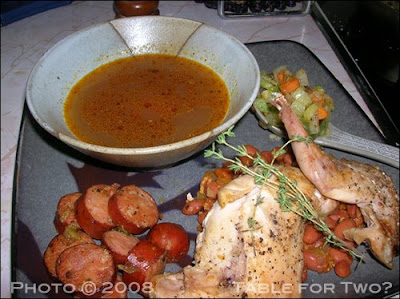
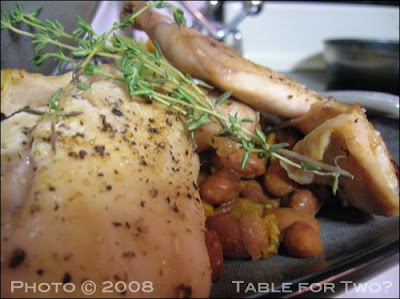
Accompaniments for the rabbit were some sliced and sauteed andouille sausage (made by Aidells, the founder of which was one of the writers of one of the most useful cookbooks we own, The Complete Meat Cookbook), some briefly stewed and spiced red chili beans, a heaping spoonful of trinity sofrito (onions, celery, and green bell peppers sauteed together with just a bit of salt and sugar - we added some carrot as well to round out the flavor), and a bowl of cajun-spiced broth.
The rabbit itself was delicious - the texture was almost exactly that of chicken, and the flavor was similar as well, but more earthy. This was a farm-raised rabbit, so I imagine that wild-caught rabbit would have a touch of gaminess to it as well, though I doubt it would ever be terribly strong. I would remove the skin next time, as it ended up a bit rubbery - we didn't achieve the crispiness I associate with good roasted poultry, and was a trifle unpleasant to bite into - but the meat was delicious, especially closer to the bone.
The true appeal of this meal was that with each bite of a single component - a slice of rabbit, or a spoonful of beans or sofrito, or a mouthful of sausage - you could taste the underlying purity of the ingredients, then chase it with a slurp of the broth and the flavors would combine in your mouth to give the distinct impression that you were, in fact, eating a bowl of gumbo. The contrast was fascinating, and great fun to eat and experience.
The truth is, though, that the cajun broth was the star of this show. It was spicy, rich, highly flavorful, and yet somehow light at the same time. I could take a thermos of this broth to work with me every day for a week and it would be a satisfying lunch all on its own, though perhaps a bit of cooked brown rice and sausage on the side would round things out. The flavor was incredible though, and I immediately requested that J make some more a few days later, this time as an accompaniment to some broiled catfish. The second time it was not as good, which leads me to believe that the recipe still needs some tweaking, but the memory of the very first spoonful that flowed over my tongue will stay with me for a long time, I think.
I won't post a recipe yet, not until I think we have it perfected and written down so that it could be repeated accurately, but here are some guidelines:
- The andouille that we ate along side the other parts of this meal actually created the base for the broth - J sauteed them in a saucepan along with maybe 1/4 cup of the trinity sofrito before removing them to eat separately with dinner. The relatively brief cooking period rendered out some of the fat and a lot of flavor, which made a huge difference to the broth in the end.
- We've discovered that the key to really authentic-tasting cajun/creole food seems to be generous amounts of garlic, paprika, chili powder, and thyme - combined with the flavors in the holy trinity, this really seems to lay down the base for a good gumbo or jambalaya.
- When in doubt, over-season. The broth was initially rather too strong when J completed it, but that was easily remedied by adding a bit of water. Making the flavors too weak at the outset, however, can require a lot of tweaking of spices later on, and it gets awfully difficult to maintain the proper balance when you're on your third or fourth addition of the same spice. Don't be afraid of them! This style of cooking demands the kinds of flavors that smack you in the face and leave you speechless as you try to figure out what the hell just happened, and that's really ok. What matters is that the proper blend is achieved, and once you get that, its always easy to just thin out the final product until you reach the level of intensity that you prefer.
I promise to share this recipe once we've gotten it down, because its just way too good to keep to ourselves. We've had tons of other ideas to use it, from cooking rice in it to using it to poach chicken, to thickening it with a roux made from andouille fat and flour and spooning it over steak, and I'd love to know what other people might think of!
For the second time in two weeks, we're eating Greek here at "Table for Two?". Well, sort of.
I won't pretend for a millisecond that there is anything traditional or authentic about this meal. Its got a little bit of an identity crisis going on. "Gazpacho... isn't that a Mexican soup?" Well, yes, but this one isn't. "Sesame chicken? Sounds like Chinese takeout." It does, doesn't it? But its not. "You're calling this Greek? I've never seen a Greek meal like that." No, I'd imagine you wouldn't have, but wait, just WAIT till you taste it.
Lets start with the chicken, shall we? Really, this couldn't be simpler. J was inspired by a recipe for "Tahini Turkey Thighs" in the Better Homes & Gardens New Grilling Book, a birthday gift from my parents last year. Their recipe was heavily influenced by Asian cuisine and called for things like soy sauce and rice vinegar, which I'm sure would be good as well but wasn't what we were in the mood for. So he simplified the recipe significantly and made a few subtle changes to swing the dish around from Asia to the Mediterranean, ending up with a marinade of only five ingredients: tahini, toasted sesame oil, honey, and S&P. And substituted chicken. Because frankly, as much as we love turkey, we really felt that this NEEDED to be chicken.
I can't speak for the quality of the original recipe, but J's take on it was delicious. The tahini in the marinade created a really fantastic crust on the outside when the chicken was cooked, and kept the inside moist and tender. The sesame flavor was made even more prominent by the addition of the toasted sesame oil, with just the barest hint of honey sweetness. Next time I think I'd squeeze a bit of fresh lemon over the chicken after cooking, just to further balance out the flavor, but as it stands it was savory and aromatic and wonderful.
The soup was, I think, a bit of a revelation for J and a proof of concept for me: gazpacho can, in fact be GOOD, and it doesn't have to be Mexican.
Gazpacho is something that always sounds really great to me in theory, but always disappoints in reality. I mean, I really can't imagine anything more summery and refreshing than a bowl of cold, fresh tomato soup, but anytime I've ever eaten it or made it myself I have really not liked it at all. But recently I had a wonderful lunch at Grayz in Manhattan during NYC Restaurant Week 2008, and my first course was essentially a gazpacho with an Italian twist. Chef Kuntz called it "Two Tomato Coulis with Three Basils", but whatever it was called it absolutely blew my mind. What struck me most was how simple, natural, and fresh the tomato flavor was - it was obvious there was very little in this soup other than the tomatoes themselves, with the upper flavor notes provided by a fresh garnish of chiffonade basil leaves and a drizzle of olive oil. I absolutely had to learn to make it myself.
Further research showed that the soup was just as simple as it seemed - basically its just a bunch of tomatoes all whizzed up in a blender with some garlic, salt, sugar, and white pepper. Thinking about that, I realized that what I don't like about other gazpachos is the other ingredients that get added; the bell pepper, cucumber, onions, jalapeno, and whatever else just cover up the flavor of the tomatoes. The fact that I've never been a big fan of cucumbers probably doesn't help, but for whatever reason it never really occurred to me to leave them out. I almost never follow recipes as-written, but I just never thought about altering this one. I know, it makes no sense to me either. I was tempted to smack myself in the forehead once I figured this out, but was afraid J might think there was something wrong with me.
Anyway, moving on.
I'm going to include the recipe here, because the soup was delicious and I savored every bite just the way it was. However, I think I could execute it better and really clarify the flavors into something much simpler and cleaner on the next go-around, so expect to see this recipe revisited probably in the very near future..
Greek Gazpacho with Fregula Sarda
Fregula sarda (sometimes spelled fregola) is an Italian pasta variety from Sardinia (I know, even MORE of an identity crisis - this poor soup must be so confused). It looks rather like Israeli couscous, but the "grains" are toasted rather than simply dried, providing a distinctly nutty flavor to the cooked pasta. I used them here mainly to add some textural complexity, which worked really well. Its not something that is particularly easy to come by, though, so you could substitute in orzo pasta, rice, or Israeli couscous, or leave it out entirely - it won't affect the flavor of the soup either way.
And yes, I used canned tomatoes for this (for shame!) because they were all I had on hand. Obviously that's something I would change next time around.
1 14oz can diced tomatoes
1 cup chicken or vegetable stock or water
2 cloves of garlic, minced
1 tbsp each fresh chopped oregano and rosemary
1/4 cup sundried tomatoes, chopped
1 pepperoncini pepper, seeded and chopped
1/4 cup green olives, chopped
1 tbsp red wine vinegar
S&P
1/4 cup fregula sarda
1 1/2 cups chicken stock or water
Toppings: fresh lemon juice, crumbled feta, chopped fresh parsley, and good extra virgin olive oil
To make the fregula sarda: heat the stock or water to boiling in a saucepan. Add the fregula and stir to keep the grains from sticking, then cover and cook for 10-15 minutes or until most of the water liquid has been absorbed and the grains are tender. Remove from heat and set aside - the grains will continue to soak up mist of the liquid that is left. If you like, you can rinse them in a colander before serving to remove any residual starches, but I didn't bother.
To make the soup: place all ingredients except for the lemon, feta, and parsley into another saucepan and stir to combine. Place over medium heat and simmer for 10 minutes or so, or until all of the components are soft enough to blend. Remove from heat and either puree right in the pan with an immersion blender (my favorite method) or pour into a standing blender and puree until smooth. The mix could then be strained through a sieve or tammis for a super-smooth product, but again, I didn't bother. Taste for seasoning - I found that my soup needed no salt at all and just a bit of fresh-cracked black pepper. White pepper would also be a good option, but I didn't have any fresh.
Pour the finished soup base into a sealable container (or into a bowl and cover with plastic wrap) and chill for at least an hour. You don't want this to be ice cold, but you don't want it warm either.
To serve, divide the soup base between two bowls. Gently spoon half the cooked fregula sarda into the middle of each bowl, then top with a squeeze of lemon, a sprinkling of feta and parsley, and a drizzle of good olive oil.
********************
Notes for next time: Aside from the fresh vs. canned tomatoes thing, I would like to simplify the soup base a bit by removing the olives and using them instead as a garnish when serving. The rosemary may have been unnecessary, so I think I'd omit it completely. I'd also like to cut out the cooking process, which I think will be a necessity if I use fresh tomatoes, so I'm expecting to need to strain the soup next time around to get rid of any little bits of the tougher ingredients (thinking of the pepperoncini here) that won't break down into the soup without cooking. Other changes may present themselves when I try this again that I can't anticipate right now, but we'll see.